 How-to
Are Boat Detailing Services for Liveaboards Worth It?
Last Updated: November 18, 2026
Quick Summary
Boat detailing services for liveaboards are worth it because a boat that never gets a break needs deeper, more frequent care than a weekend vessel. Mobile boat detailing at your dock avoids hauling out and disruption, and routine upkeep prevents costly restoration. Pricing depends on boat length, condition, and the work requested.
- Liveaboard gelcoat faces daily UV exposure, so oxidation and chalky film appear years ahead of schedule.
- One provider lists wash and wax at $35 per foot and buff and shine at $65 per foot.
- Weekly tasks include rinsing the hull, wiping high-touch surfaces, and checking under berth cushions for condensation.
- In warm, humid climates, move the weekly wipe-down and monthly head and galley deep clean up in frequency.
- Household cleaners with bleach or ammonia can dull gelcoat and damage vinyl over time.
Table of Contents
- Why Liveaboard Boats Need a Different Detailing Plan
- What Boat Detailing Services for Liveaboards Cost
- Mobile Boat Detailing Services for Liveaboards vs. Marina-Based Shops
- Building a Liveaboard Boat Cleaning Schedule That Actually Holds
- Eco-Friendly Boat Wash Products That Are Safe on an Occupied Boat
- Interior, Galley, and Head: Sanitation and Moisture Management
- Booking Dockside Detailing for Your Liveaboard
- Frequently Asked Questions
Why Liveaboard Boats Need a Different Detailing Plan
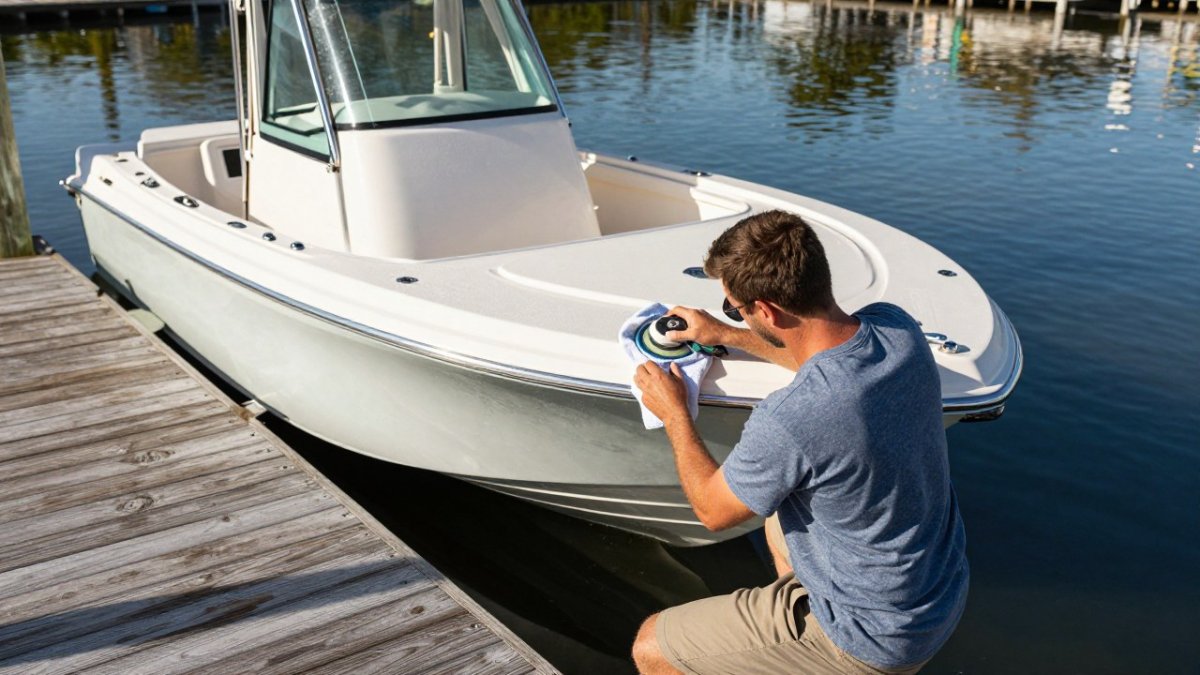
Boat detailing services for liveaboards solve a problem that weekend boaters never face: a vessel that never gets a break. When your boat is your home, every surface is in constant use, every hatch stays closed against the weather, and salt, sun, and humidity work on the gelcoat and vinyl around the clock. Mobile boat detailing at the dock has been part of our service for years, and liveaboard jobs call for a different plan than a Saturday wash.
What Full-Time Living Does to Gelcoat, Vinyl, and Ventilation
Gelcoat is the glossy outer layer that protects the fiberglass hull and deck. On a liveaboard, that layer takes UV exposure every single day, not just on weekends.
Vinyl and upholstery face a similar grind. Cushions stay out, hatches stay shut, and moisture has nowhere to go.
Ventilation is the quiet culprit. A closed-up cabin traps humidity against every surface, which feeds mildew in the head, along window tracks, and under berth cushions. Liveaboard cleaning plans have to treat airflow as part of the job, not an afterthought.
What Boat Detailing Services for Liveaboards Cost
Boat detailing services for liveaboards cost more than a standard wash because the work is deeper and the surfaces are in constant use. Pricing depends on boat size, vessel condition, and how much restoration the surfaces need.
Per-Foot Pricing and What Drives the Quote Up
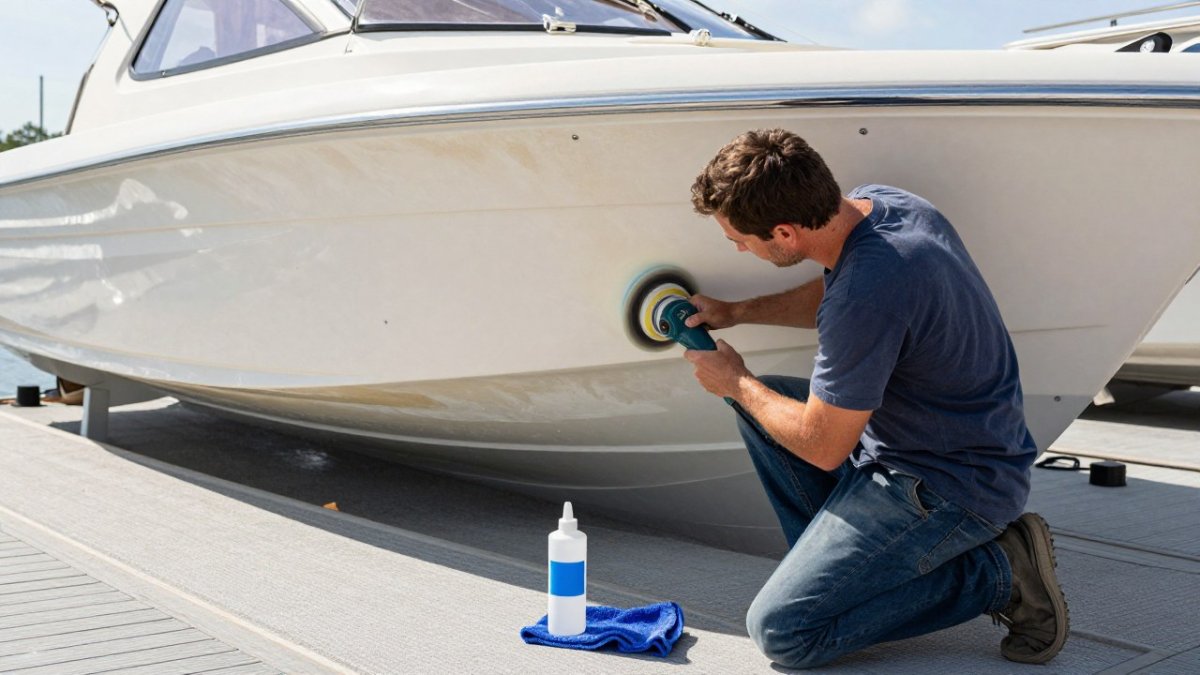
Published per-foot rates from detailing companies give a useful reference point. One marine care provider lists wash and wax at $35 per foot, buff and shine at $65 per foot, and ceramic coating from $100 per foot (MBD Marine Care service pricing). A broader cost guide puts wash and wax at $15 to $30 per foot and notes that oxidation removal can reach $75 or more per foot (Boatzon boat detailing cost guide).
Four factors push a liveaboard quote above those baselines:
- Heavy oxidation requires compounding and polishing, which adds labor hours.
- Interior deep cleaning on an occupied boat means moving belongings and working around them.
- Boat size multiplies every per-foot rate.
- Access at the slip, lift, or marina affects setup time.
Pricing depends on boat length, condition, and the work requested. Request a quote from Kleen All Boats for current pricing.
| Service Level | Typical Scope | What Drives the Price |
|---|---|---|
| Basic wash | Rinse, soap, hand dry | Boat length, water spots, salt buildup |
| Wash and wax | Wash plus hand-applied wax | Surface area, oxidation level |
| Buff and polish | Compounding, oxidation removal | How chalky the gelcoat has become |
| Ceramic coating | Protective finish after correction | Prep work, coating area |
| Interior deep clean | Galley, head, berths, vinyl | Occupied space, mildew, grease |
Mobile Boat Detailing Services for Liveaboards vs. Marina-Based Shops
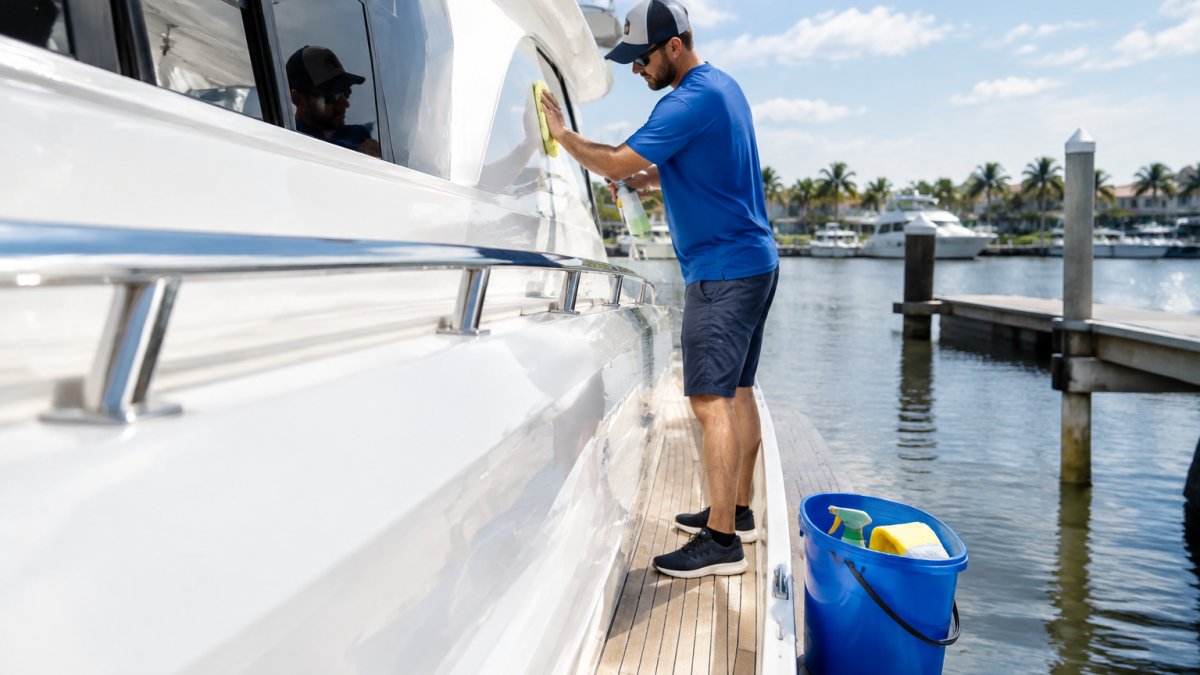
Mobile boat detailing services bring the crew to your dock, lift, or marina. A marina-based shop requires you to move the vessel or haul it out, and for a liveaboard that means disrupting where you sleep, cook, and shower.
Mobile service offers convenience and avoids hauling the boat. Shop-based work can suit heavy restoration that needs a controlled environment, and it comes with haul-out and time-off-the-water costs.
Best for: Liveaboards who want minimal disruption and recurring care. Skip if: Your hull needs structural fiberglass or paint work that requires a controlled facility.
Building a Liveaboard Boat Cleaning Schedule That Actually Holds
A liveaboard boat cleaning schedule works best when it is built around how fast your boat gets dirty, what your boat is made of, and what you can realistically do while living aboard.

A Baseline Schedule by Frequency
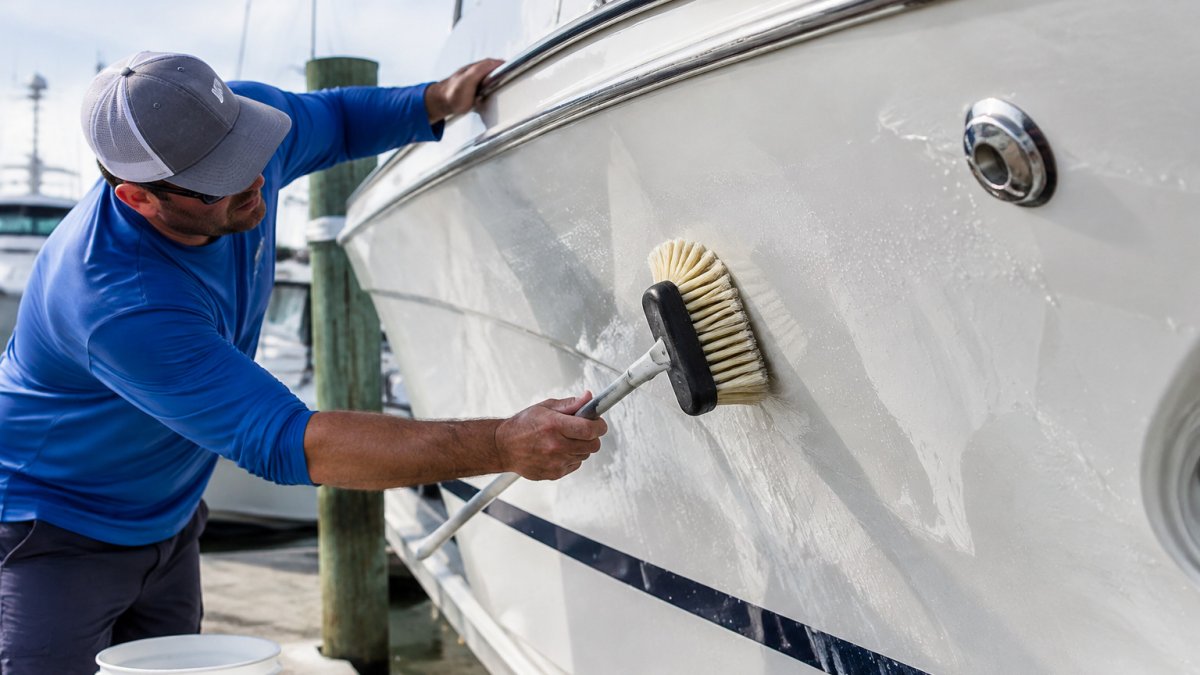
- Weekly: Rinse the hull and deck with fresh water, wipe high-touch interior surfaces (handrails, latches, faucet handles, switch plates), squeegee the head and shower, and check under berth cushions for condensation.
- Monthly: Wash and wax the exterior, degrease the galley hard surfaces, disinfect the head, inspect vinyl and canvas for mildew, and flush the bilge area with fresh water.
- Quarterly: Polish gelcoat on high-UV surfaces, treat teak, clean canvas and upholstery, and inspect window tracks and hatch seals for trapped moisture.
- Annually: Full detail, oxidation removal if needed, and a protective finish such as ceramic coating or a quality marine wax.
How Climate Changes the Schedule
Heat and humidity accelerate mildew and condensation, so in a warm, humid climate the weekly wipe-down and the monthly head and galley deep clean should move up in frequency. In a dry, sunny climate, UV oxidation on gelcoat and vinyl becomes the priority, and exterior wax or a protective coating needs to be renewed more often. In a cold climate, condensation from heating and cooking inside a closed cabin is the main moisture source, so ventilation checks and wipe-downs of cold surfaces such as window frames and hull sides belong on the weekly list.
How Materials Change the Schedule
Gelcoat, teak, vinyl, canvas, and stainless each age at different rates, so a schedule should be built around the materials your boat actually has. Gelcoat benefits from regular washing and periodic wax, teak needs cleaning and oiling based on sun and salt exposure, vinyl and upholstery benefit from cleaning and mildew prevention, and stainless benefits from fresh-water rinsing to prevent salt pitting.
Prioritize Routine Upkeep Over Restorative Work
The mistake we see most is treating everything as a spring project. On a liveaboard, small tasks done often beat big tasks done rarely.
Watch out: a schedule copied from a weekend boater will under-serve a liveaboard, because the boat never gets a break between outings. If your boat is occupied every day, assume the interior tasks need to happen more often than the exterior ones.
Eco-Friendly Boat Wash Products That Are Safe on an Occupied Boat
Eco-friendly boat wash products matter more on a liveaboard because you live inside the space being cleaned. The product has to lift salt and grime without leaving residue on surfaces you eat from, breathe near, or draw drinking water through. That is a different standard than a product that is merely labeled biodegradable.
What to Look For on the Label
Look for products labeled biodegradable and free of harsh solvents, and prefer low-odor or fragrance-free formulas for interior work. For exterior washing, a marine-safe wash soap that does not strip wax is the baseline. For interior work, the priority is a formula that rinses clean from hard surfaces and does not leave a film on vinyl or gelcoat. If a product's label does not list its intended surfaces, treat that as a reason to keep it off the boat.
Ventilation and Residue in a Closed Cabin
A liveaboard cabin traps fumes. Run hatches and fans before, during, and after interior cleaning, and work one zone at a time so fumes do not accumulate. Rinse interior hard surfaces with fresh water after cleaning, and wipe them dry so residue does not sit on surfaces you touch or set food on. Pay particular attention to the galley counters, the head, and any surface near the berth, where you spend the most time close to the cleaned material.
Potable Water, Pets, and High-Touch Surfaces
If your boat has a potable-water system, keep cleaners away from fill ports, tank vents, and any fitting that connects to the drinking-water supply. Rinse and dry faucets and sink surrounds after cleaning. If you live with pets, keep them out of the zone being cleaned until surfaces are dry and odor has cleared, and choose fragrance-free formulas where possible. High-touch surfaces such as handrails, latches, and switch plates should be cleaned with a product you are comfortable having on your hands, then rinsed and dried.
Exterior Products and Marina Runoff
Kleen All Boats uses eco-friendly washing and detailing products, and our dockside work keeps runoff in mind. If you want to see the specific products we recommend for gelcoat-safe washing, our guide to eco friendly boat wash products that protect your gelcoat covers what to look for and what to avoid.
Watch out: household cleaners with bleach or ammonia can dull gelcoat and damage vinyl over time, and they leave fumes in a closed cabin that take hours to clear. Do not substitute a household product for a marine-safe one just because it is on hand.
Interior, Galley, and Head: Sanitation and Moisture Management
Sanitation and moisture management separate a liveaboard detail from a standard interior cleaning.
The galley needs degreasing on hard surfaces, including the stove surround, backsplash, and cabinet fronts.
Bilge odors are the signal most owners miss. A musty smell below deck usually means trapped moisture or a ventilation problem, not just a dirty bilge. Address airflow first, then clean.
If you want this handled as part of a full service, our boat cabin detailing service covering salons, galleys, heads, and berths explains what a professional deep clean includes.
Booking Dockside Detailing for Your Liveaboard
Booking dockside detailing starts with a quote request that covers your boat's length, condition, and access at the slip.
A few things speed up the process: clear access to the waterline, shore power and freshwater available at the slip, and a heads-up about any surfaces that need special care, such as teak or canvas. If you are new to mobile service, our guide on how to book a mobile boat cleaning service walks through the steps.
When you are ready, contact Kleen All Boats to request a quote for your liveaboard. Kleen All Boats builds custom packages tailored to your boat's needs.
Full-time living puts more demand on your boat than any weekend schedule can match, and that is exactly where a recurring detailing plan earns its keep.
Frequently Asked Questions
What does boat detailing include for a liveaboard?
A liveaboard detail goes beyond a wash and wax. Kleen All Boats offers mobile, hand-applied detailing that can range from a basic wash to a full bow-to-stern restoration, with packages built around your boat's specific needs. Because someone lives aboard, the crew also has to work around personal belongings, keep cleaners low-odor, and protect potable water and food surfaces. Ask any provider to spell out exactly which interior and exterior tasks sit inside the package before you book.
How much do boat detailing services for liveaboards cost?
Pricing depends on your boat's size, condition, and the work you need. Kleen All Boats builds custom packages, so request a quote for your specific boat to get current pricing.
Can a mobile boat detailer work at my marina or dock?
Yes, that is the point of mobile boat detailing services for liveaboards. The crew works at your dock, lift, or marina, so you do not need to haul the boat for detailing. Check with your marina about its rules for outside contractors before booking.
How often should a liveaboard boat be detailed?
An occupied boat in a saltwater slip collects grime faster than a weekend boat, so plan on a wash every two to four weeks, a wax or spray sealant every two to three months, and a full detail with compounding once or twice a year depending on sun exposure. Interior deep cleaning fits best every one to two months. Build the liveaboard boat cleaning schedule around your own use: cooking, guests, and pets all shorten the interval. Recurring service keeps the gelcoat from ever reaching the oxidation stage.