 Comparison
Mobile vs Shop Boat Detailing: Which Fits Your Boat
Last Updated: November 22, 2026
Quick Summary
Mobile boat detailing brings the work to your dock, lift or marina, so the boat never has to be trailered or hauled. A shop service suits major restoration and heavy compounding that needs covered, controlled conditions. For routine care on a boat kept in the water, mobile service is usually the more convenient choice.
- Mobile service needs no trailering or hauling, which saves time and transport costs.
- Shops suit heavy compounding and jobs needing sheltered, controlled conditions.
- Compare quotes by normalizing scope and length, then adding travel or haul-out fees.
- Boats under about 24 feet are easy to serve either way; convenience usually decides.
- Scheduled visits work better than one-off cleanings for boats that sit in slips between trips.
Table of Contents
- Mobile Boat Detailing vs Shop Service at a Glance
- Mobile Boat Detailing vs Shop Service Cost
- Convenience, Time and Boat Logistics
- Boat Size, Storage and Transport
- Marina Rules, Water Use and Runoff
- Finish Quality, Compounding and Polishing Limits
- Boat Detailing Service Checklist Before You Book
- Which Jobs Suit Each Setting and How Detailing Protects Resale Value
- Booking Dockside Care for Your Boat
- Frequently Asked Questions
Mobile Boat Detailing vs Shop Service at a Glance
Boat detailing is the process of cleaning, protecting and restoring a vessel's hull, deck, interior and fittings. Kleen All Boats, a family-owned mobile detailing service, brings that work to your dock, lift or marina. A shop service asks you to haul or trailer the boat to a facility. Both can produce a finished result, so the real question is which setting fits your boat, your schedule and the job itself.
Many owners assume a shop always produces better work. Industry comparisons from detailers such as TJ's SLC mobile versus shop detailing guide argue that results are largely identical for most services, and the difference comes down to convenience. That claim is made about detailing in general, not boats specifically, so treat it as a starting point rather than a verdict.
Here is the core trade-off in plain terms:
| Factor | Mobile (at your dock or lift) | Shop (boat brought to facility) |
|---|---|---|
| Transport | None needed | Trailering or hauling required |
| Work environment | Open air, weather-dependent | Controlled, covered space |
| Best for | Routine care, washes, maintenance | Major restoration, heavy compounding |
| Your time | Minimal | Travel, drop-off and pickup |
Mobile service offers convenience and keeps the boat in its slip. A shop may suit jobs that need shelter from wind, sun and humidity, or equipment that is hard to bring to a dock.
Mobile Boat Detailing vs Shop Service Cost
Pricing is where most owners start, and it is where the most confusion lives. Pricing depends on boat length, the condition of the surfaces, access at the dock, and which tasks you request. Contact us for a quote tailored to your vessel.
What we can do is explain how boat-specific quotes are built, so you can compare a mobile quote against a shop quote line by line instead of guessing.
The five cost drivers that actually move a boat quote:
- Length and surface area. Most operators price by the foot, and length is usually measured along the hull (LOA), not the waterline. A 24-foot center console and a 24-foot walkaround can carry different labor because of freeboard, topsides and deck layout. Ask how length is measured before you compare two quotes.
- Condition. A maintained hull that gets a routine wash and wax is a different job from a hull with chalky oxidation, waterline staining or faded gelcoat. Oxidation removal and compounding can multiply labor hours versus a maintenance wash, and that multiplier applies in both settings.
- Access. A boat on a lift with a clean dock and nearby water and power is faster to work on than one wedged into a tight slip with no hose bib. Access affects setup time, and setup time is billable in either setting.
- Scope. Hull only, hull and deck, interior, teak, canvas, ceramic coating, each adds tasks. Confirm whether the quote includes the waterline, rub rail, stainless, and interior vinyl, because those are common add-ons.
- Travel and facility fees. A mobile quote may include a travel or dock-access charge. A shop quote may include haul-out, blocking, launch, or storage-day fees that are separate from the detailing labor. Compare the all-in number, not the headline rate.
How the two settings tend to compare on cost:
Mobile service avoids the commercial overhead of a shop building, and it avoids haul-out and transport costs for the owner. Industry comparisons such as Two Bros Mobile Detail's mobile versus shop comparison suggest mobile pricing can be comparable to or lower than shop pricing for that reason. But that advantage shrinks or reverses when the job needs covered space, controlled lighting, or heavy compounding that takes multiple passes, a shop may complete that work more efficiently, which can offset its overhead.
Published rate sheets, such as Mobile Marina's per-foot boat wash and detailing rates, show how per-foot pricing is structured by service level. Use those as examples of structure, not as a fixed price list for your boat.
A transparent way to compare two quotes:
- Normalize both quotes to the same scope and the same length measurement.
- Add the shop's haul-out, transport, and storage-day fees to its detailing line.
- Add the mobile provider's travel and dock-access charges to its detailing line.
- Compare the all-in totals, then compare what happens if the job needs a second pass.
Watch out: a low per-foot rate can hide a narrow scope. If one quote covers the hull only and the other covers hull, deck and waterline, the cheaper number is not cheaper, it is a smaller job.
When you compare quotes, check these points:
- Scope: Confirm exactly which tasks are included, such as hull, deck, interior or teak.
- Boat length: Many operators price by the foot, so ask how length is measured.
- Surface condition: Heavy oxidation or staining takes more labor than a routine wash.
- Hidden fees: Ask about travel, water or power use, haul-out, and any extra charges for dock access.
Convenience, Time and Boat Logistics
Convenience is the strongest case for mobile service. The crew comes to your slip, so you avoid trailering, marina transport and a second trip to pick the boat up. For owners who use the boat only on weekends, that saved time is often the deciding factor.
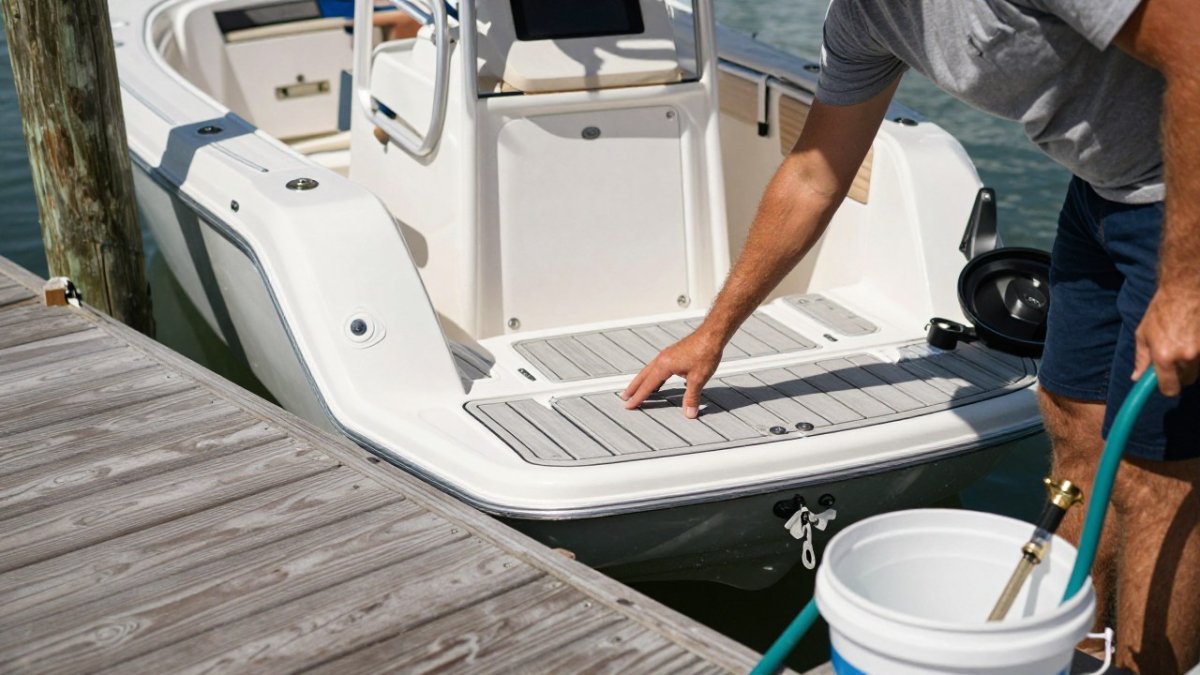
A mobile visit still requires some planning. The crew needs access to the boat, a stable place to work, and, in most cases, water and power at the dock. Clear the deck of loose gear and tell us about any fragile fittings before we arrive. A boat that sits in a slip for months between trips benefits from scheduled visits rather than one-off cleanings.
Boat Size, Storage and Transport
Boat size changes the logistics on both sides, and so does where the boat lives. The setting that fits your boat often depends less on the job than on how hard it is to move the vessel, or how hard it is to reach it in place.
Size thresholds that matter:
- Under about 24 feet. Small center consoles, skiffs and runabouts are the easiest boats to serve either way. They can be washed and polished at a dock in a few hours, and they can also be trailered to a shop without much trouble. Convenience usually decides.
- Roughly 24 to 40 feet. This is where mobile service starts to pull ahead. The boat is big enough that trailering is a chore and haul-out is a real cost, but small enough that a dockside crew can reach the hull, deck and waterline without special equipment.
- Over about 40 feet, or tall vessels with hardtops, towers or flybridges. Shops are often limited by bay height and lift capacity, so very large or tall boats may not fit at all. Dockside service becomes the practical option, though the visit takes longer and may require more reach for upper decks and masts.
Storage type changes the effort:
- In a slip. The easiest setting for mobile service, the boat is already in the water, and the crew works from the dock. The trade-off is that the hull below the waterline is not accessible without haul-out.
- On a lift. Similar to a slip, but the lift can raise the hull for better access to the running surface and waterline. Confirm the lift can be operated safely during the visit and that the crew knows the controls.
- In dry storage. The boat is on land and reachable, which is good for mobile work, but the storage facility's rules on washing, water use and runoff apply. Some dry stacks require the boat to be moved to a wash bay.
- On a trailer at home. Mobile service can work well here if you have water, power and a level surface. A shop visit means towing, which adds time and handling risk before any detailing begins.
Transport is the main cost of a shop visit. Hauling or trailering adds time, fuel, and handling risk, and a shop may charge for haul-out, blocking, launch, or storage days on top of the detailing labor. For a boat kept in a slip, that round trip can exceed the value of the detailing itself on a routine wash.
Watch out: a boat that sits in a slip for months between trips accumulates waterline staining and salt film that a quick rinse will not remove.
A boat that sits in a slip for months between trips benefits from scheduled visits rather than one-off cleanings. Match the setting to the storage type first, then to the job.
Marina Rules, Water Use and Runoff
Marinas set their own rules for work performed at the dock, and many restrict what can enter the water. Before booking any service, check your marina's policy on washing and chemical use. Ask any provider how they keep runoff under control and how they explain their approach.
Florida boaters should also understand that environmental expectations apply to both settings. Runoff must be managed carefully at the dock. Ask any provider how they handle water and waste before the visit.
Finish Quality, Compounding and Polishing Limits
Finish quality depends on the technician and the products used. Routine washing, waxing and interior cleaning can be handled well on site, and heavy work requires careful assessment. Deep oxidation, scratches or faded gelcoat often need compounding and multiple polishing passes, which are easier to control in a sheltered space.
Mobile work can be affected by weather. Wind can blow dust onto a fresh finish, and humidity or direct sun can make compounds dry too fast, so calm, shaded conditions are preferable for heavy restoration.
Boat Detailing Service Checklist Before You Book
Use this checklist before you schedule either setting:
- Confirm which tasks are included in the quote
- Note your boat's length and any hard-to-reach areas
- Check your marina's rules on washing and product use
- Confirm water and power access at the slip, lift or dock
- Clear loose gear, cushions and personal items from the work area
- Photograph any existing scratches, stains or damaged fittings
- Ask how runoff and wash water are handled
- Agree on a timeline and whether the visit can be repeated seasonally
You can review the full range of interior and exterior packages on our Kleen All Boats boat detailing service page before choosing a level of care.
Which Jobs Suit Each Setting and How Detailing Protects Resale Value
Match the job to the setting. Mobile service suits routine washing, waxing, interior cleaning, waterline and stain removal, and recurring maintenance for boats that stay in the water. Heavy compounding, large restorations and work that needs covered, controlled conditions may suit a shop better.
Regular care also helps protect resale value. Consistent detailing helps slow the effects of UV exposure and salt, which can dull gelcoat and age vinyl, teak and canvas.
Booking Dockside Care for Your Boat
Dockside detailing works best when it is scheduled, not sporadic. If your boat stays in the slip while you travel, a recurring plan keeps salt and UV damage from building up between trips. Scheduled visits can be arranged before and after each boating season, with lighter maintenance in between.
To request a quote, call Kleen All Boats at (941) 356-7769. Tell us your boat's length, its current condition and the services you want, and we will build a package around your vessel. You can also send a quote request through our contact page.
Frequently Asked Questions
Is mobile boat detailing as good as shop detailing?
Mobile boat detailing can handle many routine jobs well, and the work is hand-applied. The real differences show up in work that needs controlled conditions, such as heavy compounding on a large hull, which is harder to do well in direct sun, wind or on a dock with limited space. Ask any detailer what products and methods they use and how they protect the surrounding water and dock, then compare the answers rather than the location alone.
Is mobile boat detailing more expensive than shop service?
Not necessarily. The total cost depends on boat length, the level of service and any travel or access fees. Shop service may include trailer transport costs or haul-out fees that add to the bill. Request written quotes from both kinds of providers that list the exact tasks included, so the numbers can be compared directly. Pricing varies by provider, so check Kleen All Boats directly for a current quote.
What affects the cost of boat detailing?
The main cost drivers are boat length and surface area, the condition of the gel coat or fiberglass, how much oxidation or staining needs correcting, whether compounding and polishing are included, and interior work such as vinyl, canvas and teak care. Add-ons such as waterline stain removal can raise the price. Prices depend on the specific package and the boat, so Kleen All Boats can give an accurate figure after reviewing your vessel.
Can a mobile detailer compound and polish a boat?
Compounding and polishing are part of the detailing work covered in our service descriptions, and results depend on the weather, the dock layout and the crew's experience. Heavy oxidation on older gel coat usually needs more passes and careful surface assessment, and results depend on the weather, the dock layout and the crew's experience. Ask whether the detailer uses a rotary or dual-action polisher, how they protect nearby surfaces, and what finish they expect before committing to a full restoration.
Does professional boat detailing help resale value?
Consistent professional care helps protect the appearance of gel coat, vinyl, canvas and teak. Detailing does not replace mechanical maintenance.