 ultimate-guide
Eco Friendly Marine Cleaning Products: A Complete Guide
Quick Summary
Eco friendly marine cleaning products are formulated to break down safely in water and avoid harming aquatic life, so the ingredient list, test data and proper use matter more than a green label. Biodegradable, non-toxic and marine-safe mean different things, so check each claim.
- Biodegradable means microorganisms can break a product down, but says nothing about how fast or whether breakdown products are harmless.
- Ask manufacturers which test method and species were used to support any marine-safe claim.
- Phosphates, quaternary ammonium compounds, chlorine bleach and petroleum solvents are the key ingredients to avoid.
- Check the safety data sheet, especially Section 12 on ecological information, for aquatic toxicity statements.
- Rinse boats after each outing and use a biodegradable soap every one to two weeks during peak season.
Table of Contents
- What Makes a Marine Cleaning Product Eco Friendly
- How to Verify Environmental Claims and Certifications
- Ingredients to Avoid and Their Effect on Aquatic Life
- Best Boat Cleaner for Fiberglass and Gelcoat
- Biodegradable Boat Wash Options for General Cleaning
- Waterless Boat Cleaning Products and When They Work
- Surface-by-Surface Cleaning: Teak, Vinyl, Canvas and Hull
- Runoff, Wastewater, and Cost Per Use
- Building an Eco Friendly Cleaning Routine for Your Boat
- Frequently Asked Questions
What Makes a Marine Cleaning Product Eco Friendly
Eco friendly marine cleaning products are formulated to break down safely in water and to avoid harming the aquatic life around your dock or marina, which is why a proper eco friendly marine cleaning routine starts with the ingredient list. Calling a product "green" is easy; what matters is the ingredient list, the test data behind it, and how it is used. Kleen All Boats cleans hulls, decks and canvas on Florida's Gulf Coast, and the products we choose are judged on exactly these points.
Florida's waterways are shallow, warm and often slow-moving, which means anything washed off a boat can linger. That makes the difference between a truly marine-safe cleaner and a merely "natural" one worth understanding before you buy.
Biodegradable, non-toxic, and marine-safe: what the terms mean
These three words get used interchangeably, but they describe different things. A product can be biodegradable and still be harmful to fish in high concentrations. Understanding each term helps you read labels with more skepticism.
- Biodegradable means microorganisms can break the product down over time. It says nothing about how fast, or whether the breakdown products are harmless.
- Non-toxic is a looser claim. Without a defined test, the word usually refers to low acute toxicity to people, not to aquatic organisms.
- Marine-safe should mean the product has been tested against aquatic species such as fish, algae and invertebrates. Ask the manufacturer which test method and species were used.
A practical rule: if a label makes all three claims but offers no supporting data, treat the claims as marketing until proven otherwise.
How to Verify Environmental Claims and Certifications
Many boat cleaners carry at least one green-sounding word on the front label, and few back that word with data a buyer can check. The gap between a marketing claim and a verified one is where most purchasing mistakes happen, so treat verification as a short, repeatable checklist rather than a trust exercise.
Separate the four claim types
Labels mix terms that sound similar but mean different things. Sort every claim into one of these buckets before you weigh it.
- Biodegradable. Means microorganisms can break the product down. It does not state how quickly, under what conditions, or whether the breakdown products are harmless. Look for the test method (for example, OECD 301-series ready biodegradability tests) and the percentage of the formulation that passed.
- Non-toxic. A loose, largely undefined term. Without a stated test organism and endpoint, assume it refers to low acute toxicity to people, not to fish or invertebrates.
- Phosphate-free. A narrow, verifiable claim. It tells you one nutrient is absent; it says nothing about surfactants, solvents, or aquatic toxicity.
- Independently certified. The strongest bucket, because a third party reviewed the full formulation rather than a single ingredient. The EPA Safer Choice program evaluates cleaning product ingredients against human health and environmental criteria (the EPA).
A product can be biodegradable and still be toxic to fish at the concentration that reaches the water. That is why the buckets are not interchangeable.
Read the safety data sheet first
Manufacturers of hazardous cleaning products are generally required to make a safety data sheet available under OSHA's Hazard Communication Standard. The SDS is the fastest way to see what is actually in the bottle.
- Go to Section 3 (composition) and note the surfactants, solvents, and any ingredient flagged for aquatic hazard.
- Check Section 12 (ecological information) for aquatic toxicity statements. A credible SDS names test species and endpoints; a vague one says only "harmful to aquatic life."
- Compare the concentration ranges. A quat at 0.1% and a quat at 5% are different products for runoff purposes.
Watch out: an SDS that lists no aquatic toxicity data is not proof of safety, it often means the manufacturer never tested, which is a different problem than a tested-and-clean formulation.
Check the certification, not the logo
Green leaves, blue drops, and "earth-friendly" seals are frequently self-declared. Before you trust a logo, confirm three things: who issued it, whether it reviews the full formulation or a single attribute, and whether the certification is current. EPA Safer Choice reviews the whole formulation rather than a single ingredient. Certifications that rely only on the manufacturer's own statement deserve the least weight.
Ask for aquatic toxicity data
A manufacturer with real data will share it: the species tested (fathead minnow, Daphnia, green algae are common), the endpoint (LC50 or EC50), and the concentration. Vague answers, "our product is safe for the environment", are a warning sign. You do not need to interpret the raw numbers yourself; you need to see that testing happened and that the company will stand behind it in writing.
A five-minute label workflow
- Read the front label and sort each claim into the four buckets above.
- Pull the SDS and check Section 3 and Section 12.
- Confirm any certification is third-party and current.
- Ask the manufacturer for species-level aquatic toxicity data.
- If any step comes up empty, treat the product as unverified until proven otherwise.
That workflow will not make you a toxicologist, but it will separate the products that have done the work from the ones that have only done the marketing.
Ingredients to Avoid and Their Effect on Aquatic Life
Most of the harm from boat cleaners comes from a small group of ingredients. Knowing them lets you scan a label in seconds.
- Phosphates feed algae blooms that deplete oxygen in the water.
- Quaternary ammonium compounds (quats) are strongly toxic to fish and aquatic invertebrates even at low concentrations.
- Chlorine bleach and hypochlorite react with organic matter and can produce harmful byproducts.
- Petroleum-based solvents persist in sediment and accumulate in the water column.
- Strong acids and caustics such as hydrochloric acid or sodium hydroxide can harm marine life and damage gelcoat when misused.
A common mistake is assuming that a "natural" label excludes these ingredients. Essential oils and citrus extracts can also be toxic to aquatic organisms at high concentrations, so the concentration and the full formulation matter more than the marketing.
The table below sums up the ingredients this section flags and the harm each one causes in the water.
| Ingredient | Effect on aquatic life | Note |
|---|---|---|
| Phosphates | Feed algae blooms | Deplete oxygen in the water |
| Quaternary ammonium compounds (quats) | Strongly toxic to fish and invertebrates | Toxic even at low concentrations |
| Chlorine bleach and hypochlorite | React with organic matter | Can produce harmful byproducts |
| Petroleum-based solvents | Persist in sediment | Accumulate in the water column |
| Strong acids and caustics | Harm marine life | Also damage gelcoat when misused |
| Essential oils and citrus extracts | Toxic at high concentrations | A "natural" label does not exclude them |
Best Boat Cleaner for Fiberglass and Gelcoat
For fiberglass and gelcoat, the best cleaner is a pH-neutral or mildly alkaline biodegradable formula that lifts salt film and grime without stripping the protective wax or dulling the surface. Acidic cleaners can etch gelcoat over repeated use, and harsh solvents can cause crazing.
Look for a product that is clearly labeled for gelcoat, has a published pH, and recommends dilution for general washing. Concentrated formulas can cost less per wash when diluted correctly; over-concentrated cleaners waste product and leave more residue to rinse.
Kleen All Boats uses eco-friendly products and hand-applied wax for dockside service, and a protective wax or sealant helps keep the surface resistant to UV and salt.
Biodegradable Boat Wash Options for General Cleaning
For routine washing, a biodegradable boat wash should clean well at a dilution you can measure, rinse clean, and avoid residue that builds up on the hull waterline. A mild, concentrated soap is often sufficient for routine washes, with stronger cleaners reserved for stubborn stains.
Compare options on three measures: the verified biodegradability claim, the recommended dilution ratio, and the cost per wash. A cheap concentrate that requires heavy dilution may cost more per use than a higher-priced formula. Check the label and do the arithmetic before you buy; pricing varies by product, size and retailer, so confirm current prices directly with the manufacturer or your supplier.
Waterless Boat Cleaning Products and When They Work
Waterless products are sprays that loosen dirt so it can be wiped away with a microfiber towel. They suit light dust, fingerprints and salt film between full washes, and they produce no runoff at the dock. They do not replace a full wash on a heavily soiled hull, and they can scratch if grit is left on the surface before wiping.
Use waterless products on dry, shaded surfaces and keep a supply of clean towels. If you find yourself wiping a large area with grit visible, switch to a full washdown with a biodegradable soap instead.
Surface-by-Surface Cleaning: Teak, Vinyl, Canvas and Hull
Each surface on a boat tolerates a different amount of alkalinity, dwell time, and mechanical action. Using one product and one method across the whole boat is the fastest way to dull gelcoat, dry out teak, or crack vinyl. The guidance below assumes a concentrated biodegradable boat wash diluted per the label; always confirm the manufacturer's ratio before mixing.
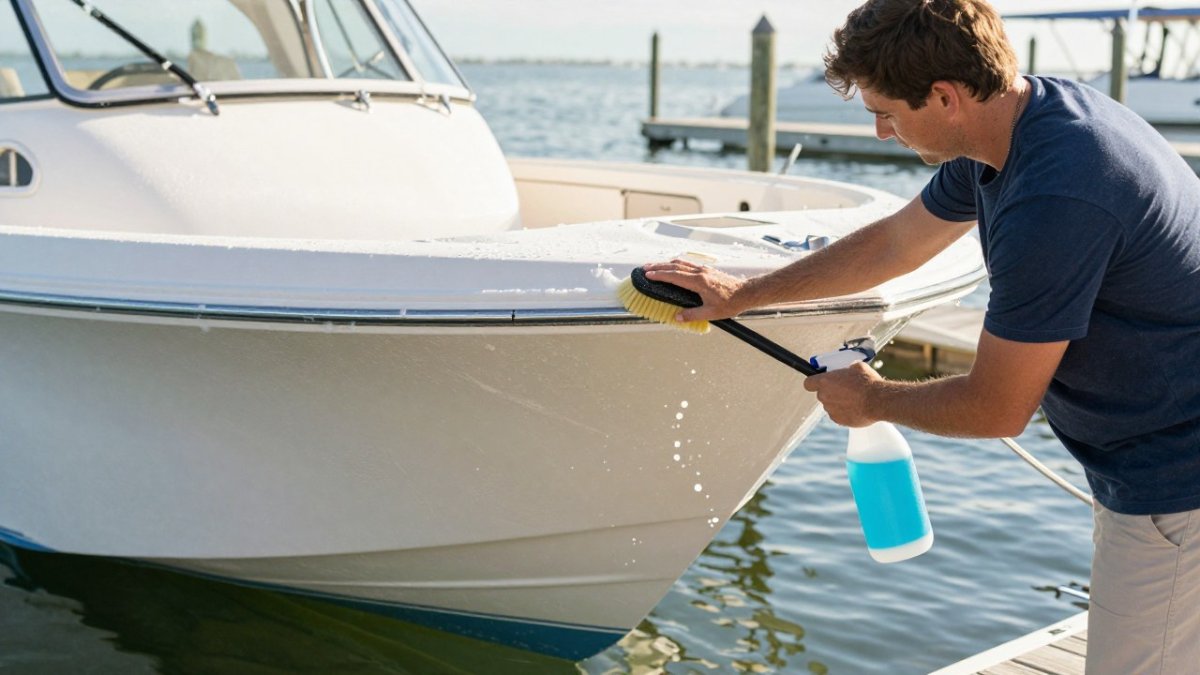
Fiberglass and gelcoat
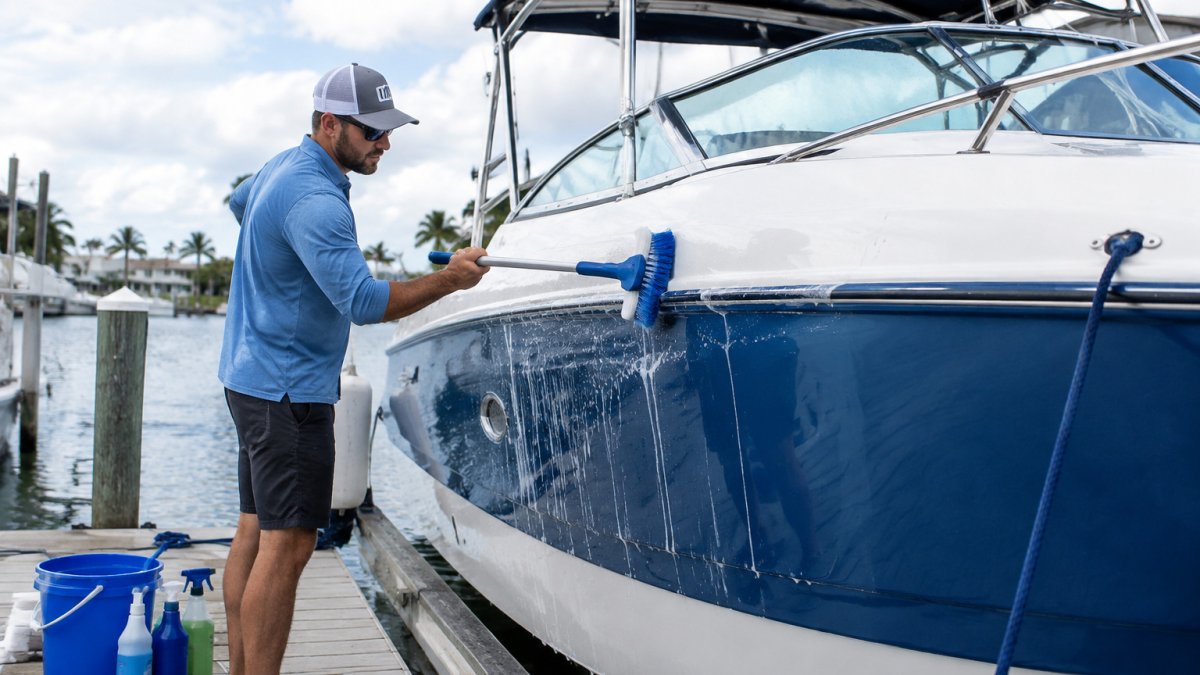
Use a pH-neutral or mildly alkaline wash. Mix to the label's general-washing dilution and apply with a soft wash brush or mitt. Let it dwell only long enough to loosen salt film and grime, then rinse before it dries. Work top-down and rinse between sections so dirty water does not run over clean gelcoat.
Watch out: acidic cleaners and harsh solvents can etch or craze gelcoat over repeated use, and over-concentrated wash left to dry leaves a film that attracts dirt. Rinse thoroughly and follow with wax or sealant to protect the finish.
Teak
Gray, weathered teak needs a teak-specific cleaner rather than a general boat wash. Apply with a soft-bristle brush, work along the grain, and rinse thoroughly before the cleaner dries. Avoid chlorine bleach, which can leave the wood blotchy and raise the grain. Let the teak dry fully, then apply oil or sealant to restore color and slow graying. Some teak cleaners are harsher than others; reserve stronger formulas for badly weathered wood and test on a hidden area first. For vinyl-safe products used on seats and cushions, see boat vinyl cleaning in Port Charlotte.
Vinyl
Wipe seats and cushions with a mild soap-and-water solution and rinse. Use a soft cloth or sponge, abrasive pads leave permanent scratches. For mildew, use a dedicated vinyl cleaner, test on a hidden spot, and keep dwell time short so the cleaner does not dry into the grain. Rinse and dry before the boat is covered.
Canvas
Biminis and covers respond well to a gentle biodegradable soap and a soft brush. Wet the fabric first, apply diluted soap, scrub lightly, and rinse thoroughly so no residue remains to attract dirt or weaken the fabric. Let canvas dry completely before folding or storing to prevent mildew. Avoid bleach and strong detergents, which strip water repellency and shorten fabric life.
Aluminum and metal
Use a pH-neutral wash and avoid strong acids or caustics, which can pit aluminum and stain stainless. Rinse promptly and dry to reduce water spotting. Do not let any cleaner dwell on bare metal in direct sun.
Tools and technique that apply to every surface
- Rinse first to remove loose salt and grit; scrubbing dry grit into a surface causes scratches.
- Use the least amount of product that works, mixed at the label ratio.
- Keep separate brushes or mitts for hull, teak, and canvas so grit and cleaner do not transfer.
- Rinse again after washing, and never let wash water dry on the surface.
The method matters as much as the product: rinse, scrub gently at the right dilution, and rinse again.
Runoff, Wastewater, and Cost Per Use
Wash water carries whatever you wash off the boat into the surrounding water. Where possible, wash on a surface that drains to a collection point, use the least amount of product that works, and avoid washing at the water's edge during heavy rain. Some marinas and local rules restrict what can be discharged, so check with your dock or marina operator first.
Cost per use is the figure that matters for budgeting. Calculate it by dividing the price of the bottle by the number of washes it yields at the recommended dilution, using the manufacturer's current pricing. Confirm prices with the manufacturer, since they change by product, size and retailer, and quote your own numbers rather than relying on general figures.
Building an Eco Friendly Cleaning Routine for Your Boat
A sustainable routine is simpler than most owners expect. Rinse the boat after each outing to remove salt before it dries. Wash the hull and topsides with a biodegradable soap every one to two weeks during peak season, and use a waterless product between washes. Clean teak, vinyl and canvas on a monthly schedule, adjusting for how often the boat is used and how much sun and salt it sees.
Schedule a professional cleaning and protection service at least once or twice a year. Kleen All Boats performs mobile dockside service, so the work happens where your boat is kept. Florida Fish and Wildlife Conservation Commission boating environmental guidance offers additional tips on keeping waterways clean.
For current pricing on dockside eco-friendly cleaning and restoration, contact Kleen All Boats at (941) 356-7769 for a quote.
Frequently Asked Questions
What are some environmentally friendly products for cleaning a boat?
Look for concentrated, biodegradable boat soaps, waterless wash sprays and cleaners labeled non-toxic or marine-safe. Products that avoid phosphates, chlorine bleach, and strong acids or caustics generally cause less harm when rinsed into water. Check the label for dilution instructions, because using less product per wash reduces the amount that reaches the water. Pricing varies by brand, concentration and package size, so compare cost per use rather than the sticker price, and check the manufacturer's website for current figures.
Is Simple Green safe for marine use?
Simple Green is marketed as a biodegradable all-purpose cleaner, but whether it suits a boat depends on the surface and the dilution. Many boaters use diluted versions on hulls and decks, while avoiding it on certain finishes that a manufacturer does not recommend. Always test a small hidden area first, rinse thoroughly, and avoid letting concentrate reach the water. Confirm the product's suitability for your specific gelcoat, vinyl or teak with the manufacturer before regular use.
What ingredients should I avoid in marine cleaning products to protect aquatic life?
Avoid products that list phosphates, chlorine bleach, petroleum solvents, and strong acids or caustics such as concentrated hydrochloric acid or sodium hydroxide. Volatile organic compounds can also contribute to air and water pollution. Ingredient lists are the most direct check: a product that discloses its surfactants and avoids the substances above is generally a safer choice for marinas and nearshore waters.
Are waterless boat cleaners effective for routine maintenance?
Waterless cleaners work well for light dust, fingerprints, salt film and bird droppings between full washes, and they use no hose water, which keeps runoff from reaching the dock. They are less effective on heavy grime, dried algae or thick salt crusts, which still need a proper wash with a rinse. Use them on clean, cool surfaces, wipe with a soft microfiber towel, and switch to a conventional biodegradable wash when dirt builds up.